
Before transitioning into Product Management, I led a small team of Customer Success Managers. At our company, the Product Manager would send updates when new features and improvements were released. I’d read these emails to identify what was important for my team and our customers. The emails were usually clear.
At that time, I focussed on just three key questions: What was released? Is this relevant for me or my team If relevant, how does it benefit our work? Any information beyond these questions wasn’t particularly useful for my role.
This context is important because despite knowing the needs of the team, I still struggled to share product update emails that were helpful.
I got very excited about features and I wanted to share every tiny detail with the team. I used to write lengthy release update emails. My good friend and ex-manager once told me, “Your CEO (or team) doesn’t have time to read novels”(referring to my long emails). In any other setting, this might sound harsh, but coming from a friend, I asked how I could improve. His suggestion was simple: be specific and concise. I tried to do exactly that.
I adopted different formats for different features. For example, suppose you launched something really big, which is worthy of a blog post or even a PR article, you might want to plan that very differently. By the way, this article won’t cover it. Let’s be real, on a regular basis, you are probably doing bug fixes, product improvements and fixing technical debts. How do you then make it easy for yourself as well as easy for team to understand?
I am sharing a template that I have used regularly.
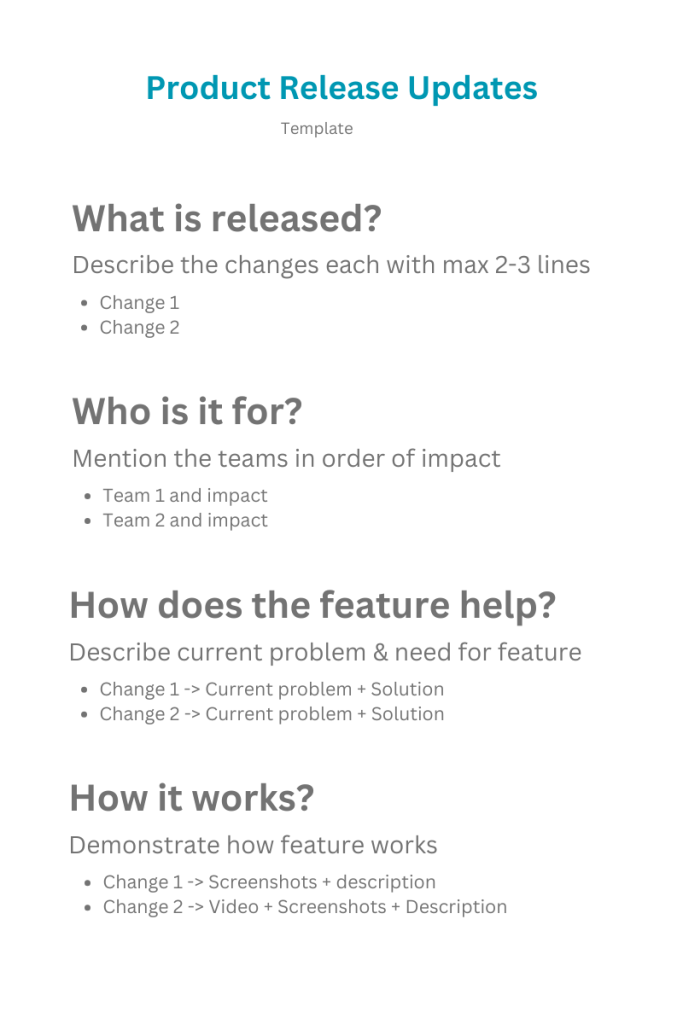
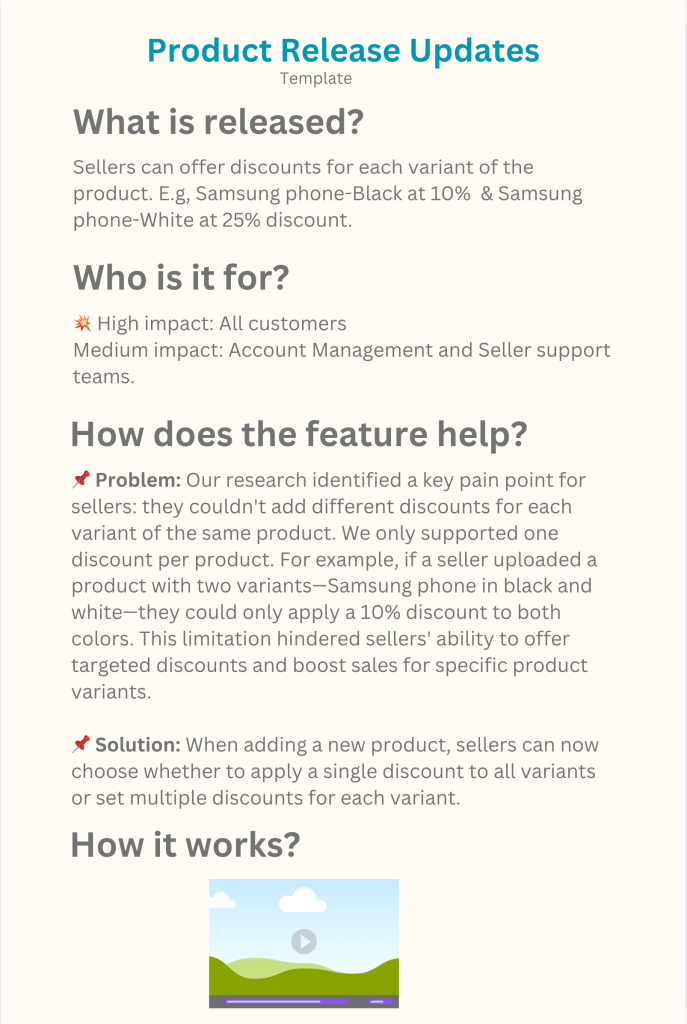
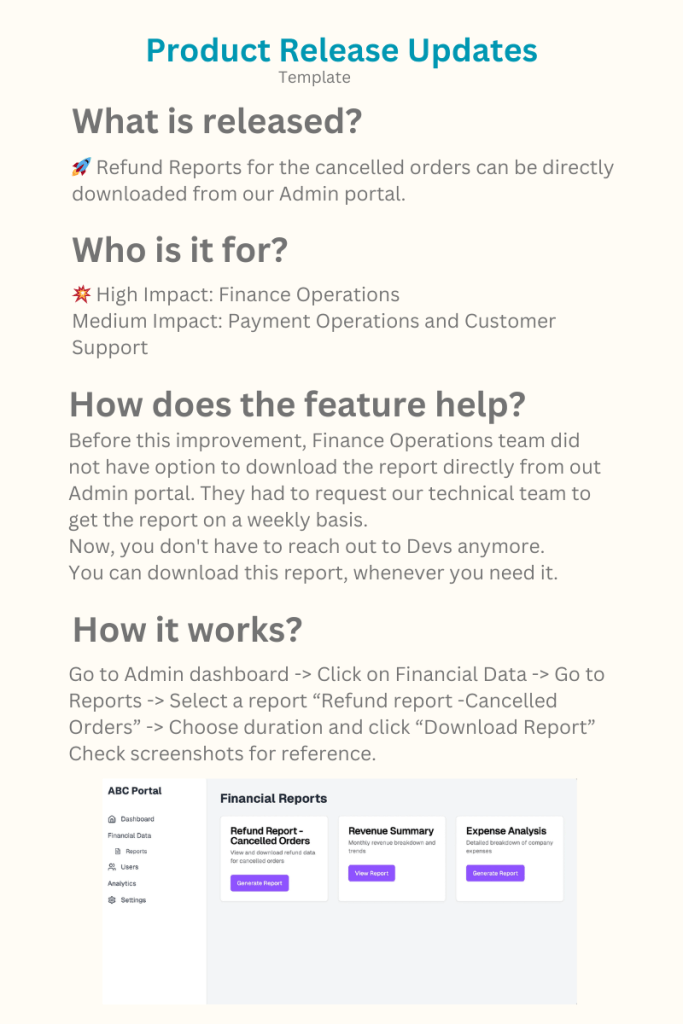
Now, let’s see how it will work realistically. We will take 2 examples for an imaginary order and catalog management product meant for Sellers of an e-commerce website.
Example 1: New feature in the product, solves a big pain point for the customers.
Example 2: Improvement to an existing feature that solves major problem for the internal Finance Operations team.
Finally, just because I suggested a template does not mean it’s the right way or the only way. Come up with your own template but keep the basics in mind — No one needs to read a novel and yet, everyone needs to know meaningful changes in the product release. Try to make it concise.
 Maria Martin
Leave a comment