
In 2007, Amazon’s Kindle device sold out within few hours of its launch. Since then they have sold millions of devices. But why did Amazon start selling an e-reading device? Especially, they sold those devices at no profit. In 2012, Forbes reported that Jeff Bezos confirmed “we sell the hardware at our cost, so it is break-even on the hardware” in an interview with BBC.
If it is not about the hardware then what is it about? You guessed it right, it is not just about the hardware, it is the ecosystem at play.
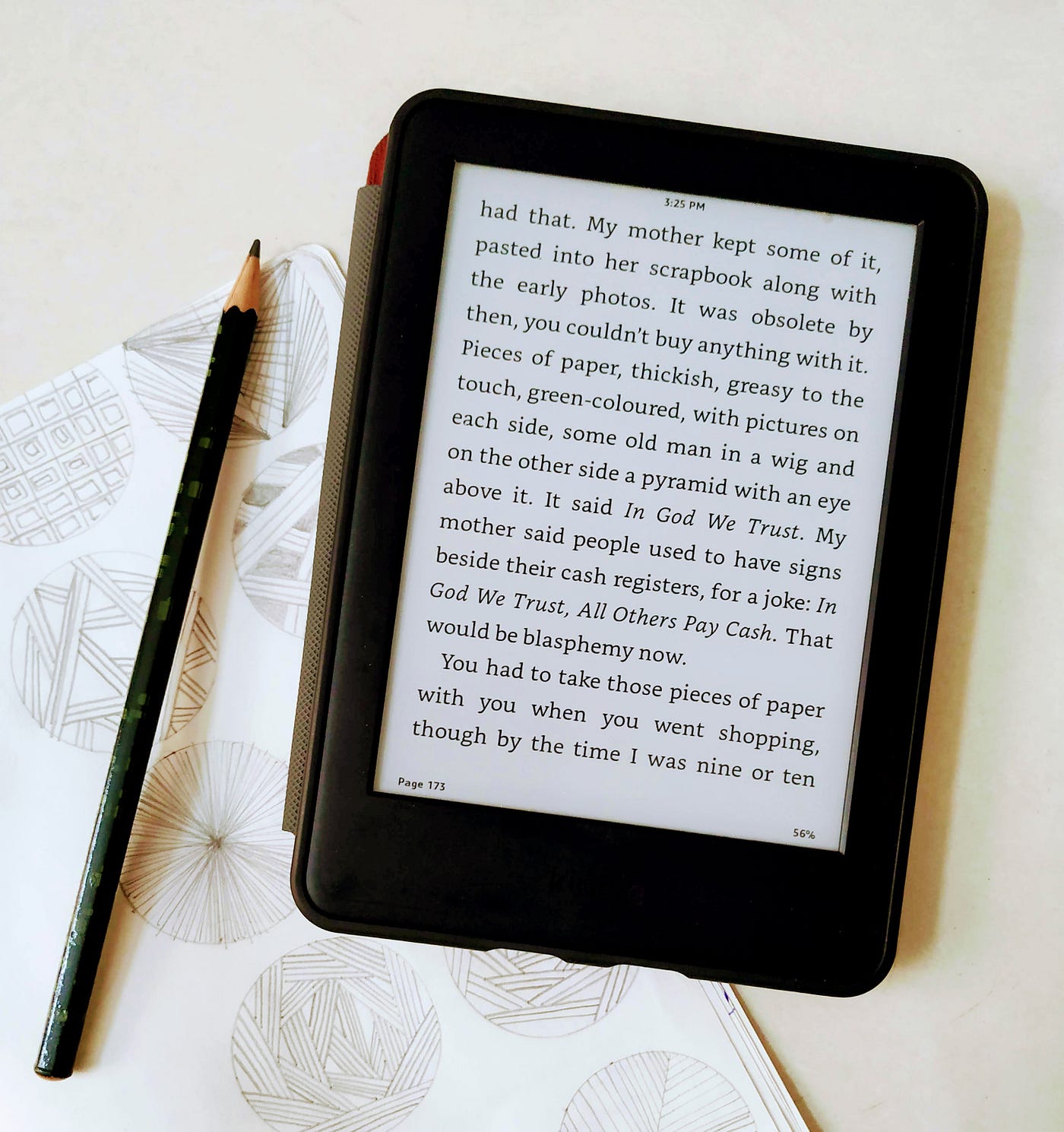
Few years ago, I bought a basic Kindle. I am not an avid reader but I do like to carry books on vacation. With Kindle, I could carry more than one book everywhere I go. Ultimately, it became a habit to read on Kindle than to buy physical copies. Next thing I know I am buying e-books off of Amazon, loading on my Kindle and reading them there. They even have free books for Amazon Prime subscribers, discounts for Kindle editions. I am locked in fully!
This is an incredible way of achieving retention of the customer through multiple products. We will come to that, but let’s go back a little.
Kindle’s history: technology and design
It was first released in Nov, 19 2007. By this time Amazon was already 12 years into the business. There is a very detailed article on its history and how it came to life on Amazon’s site. I recommend you check it out. Amazon’s own research lab, Lab126, developed the Kindle. The device was the result of four years of intensive research and testing.
The technology
Kindle uses the E-Ink technology for their devices. One of the crucial features of this technology is its paper-like display. There was nothing revolutionary about the E-ink technology itself. It existed since 1997, though it was popularised by Amazon Kindle. The E-ink technology has manifold applications but the biggest by far was the e-reader.
Additionally, technology for storing large amounts of data in smaller memory spaces was rapidly advancing. This meant, storing text in computer is very cheap in terms of memory usage. You can see how .doc file takes 5KB but an image file .png can be much larger often 5MB or more. It was only matter of time, when kids would start doing their assignments on laptop, college students researching on internet instead of libraries and working people reading online more than hardcopies.
For Kindle, it meant you can carry hundreds of digital books with you in a 174g device.
Now, as a Product Manager, I take away couple of things from this:
Instead of looking for new solutions and waiting for new technologies to arrive, find ways to solve customer’s problems with existing solutions. It makes you focus more on the problem and solve the right ones. Hard to do but worth doing.
You could not come up with such a product in 1980s because we did not have that technology at all. You can only continuously research and iterate on products but understand that you may have constraints on the existing solutions available at that time.
The Design
A very important aspect for such devices should be the comfort of reading. If you are going to spend 2 hours reading, you cannot afford to strain your eyes. While E-ink technology provided paper-like display, there were other design considerations as well.
One such feature is changing fonts and size of the text! They even got their own font called, Bookerly. You cannot do that with physical books. Your reading experience is determined by the Publisher who chose the fonts and size for you.
For the visually impaired, there is an option to read out the text. Their blog covers more on this topic of Accessibility and Inclusion.
Kindle Basic device’s design is very intuitive and minimal. Their recent versions, however, are loaded with features.
Kindle does claim to have good design for form factor but based on my personal experience, I think it can be better. I cannot hold kindle for long periods of time. By the way, I experience same problem with books. Ergonomics should get better for such devices.
However, the first version of Kindle device was nothing like its current version, they had to completely change their design. You can read this post by Josh Hrala on how Kindle has evolved over time in design.
You have to get the basic requirements right when designing new products. While you can quickly iterate and ship refined versions, it cannot fail on the core value proposition. In case of Kindle, the value proposition was to read a physical book on a digital device in the most accessible way.
Scope the minimum deliverable but consider usability and accessibility for the bare minimum features in your product.
Having the right technology and the right design does not always guarantee success. You need distribution. For Amazon, it was not a challenge. Amazon had books and users. They needed to build the connector; a platform for digital reading era.
Platform for Readers, Writers and Publishers
Until Kindle’s launch, Amazon had physical book sellers on their marketplace. They needed to create supply for the digital books.
The platform
Amazon allowed authors to directly publish their e-books. This created a marketplace for authors and readers and saw some pretty nice growth too. TechCrunch article states, “Between 2010 and 2015 alone, the number of ISBN registered titles jumped 375 percent, from 152,978 to 727,125. Amazon’s CreateSpace accounts for the largest share of that growth.”
In a traditional setup, small-time authors would have to wait for their publishers to approve and agree to print. Publisher’s credibility and distribution could make or break the success of the book. By directly selling to consumers, less renowned authors could publish directly. This unlocked an incredible opportunity.
On the consumer side, they were locked in by the Kindle device purchase already. Amazon can now offer free books for Prime subscribers, or discounts on Kindle edition.
Although Amazon offers enormous platform to the authors, it did not really eliminate all the challenges of traditional model.
Challenges of the platform
Amazon requires exclusivity from its Kindle Direct Publishing (KDP) Select authors, meaning they can only sell their books on the Kindle Store, and not on any other digital bookstores, or even on their own websites.
As per their article Amazon charges royalty of 35% or 70% depending on territories the books are sold in. This is not very different from what traditional publishers would do.
Authors have to work hard to promote themselves and attract new readers in a crowded marketplace because suddenly, everyone has option to publish.
It is hard to know how Amazon team plans to handle such challenges but it certainly makes me think more. In a marketplace product, the balance between supply and demand has to be healthy enough for it to sustain. What happens if authors are unhappy? What happens when a lot of authors publish directly but there are no e-book sales? These are not easy problems, companies spend millions on research to handle such challenges.
Short term success is good but it is good to have an idea about the potential challenges that could arises in the future.
The ecosystem
I mentioned in the beginning that I was locked in the Amazon’s ecosystem.
The ecosystem is basically this, for every purchase of a product there is an auxiliary product or a service from the same company.
No matter which product you buy first, you can buy related product from the same company. If you buy Kindle device first, then you can buy e-books from Amazon. If you buy e-books, you might be tempted to buy Kindle and so on.
E-reading device sellers like Rakuten and Kobo are attempting build an ecosystem too.
When I first saw Amazon selling Kindle device, I thought “Why is Amazon getting into this hardware business?” This is a Product Strategy question asked in many interviews for Product Manager role. “Should Company A expand into category X?” or “Should company B launch this new product?” However, after seeing the way they grew the product, selling hardware was not the main goal, it was to create an ecosystem for the user.
I have observed this in Fintech companies that often build a baseline infrastructure first, get the customer locked in on the core product and then use this customer base to distribute new products. In India, Cred started as an app to remind you to pay credit card bills. Stripe in USA and Razorpay in India started as payment gateways. If you go to their websites now, you will see lot of other products unrelated to their core product.
Ecosystem in your context may not mean launching new products all the time. Think of micro-ecosystems of intertwined usecases that your users may not have explored yet. If you notice that a certain feature is not adopted organically, think of new usecases and how it can solve other problems that user may not be aware of. Think of ecosystem and keeping the user in that ecosystem.
As a Product Manager, you often have to step outside of the Jira board 😉 to think of ecosystem at play.
Final words
If you made it this far here is a fun fact about Amazon Lab126, they named it after their logo, 1 for A and 26 for Z.
Let me leave you with some takeaways:
- Think of your product features as tiny ecosystem of its own.
- Keep your user in the ecosystem of your product.
- Leverage existing solutions and technologies before jumping to creating new ones.
- You cannot hack product’s quality. Decide on minimal scope but deliver the best you can.
- Always evolve, don’t let the product go stale.
- Think about the product’s distribution and marketing strategies while you execute.
- Acknowledge the fact that a product’s success is a combination of its quality + market forces + timing.
 Maria Martin
Leave a comment